1800-1200-2555
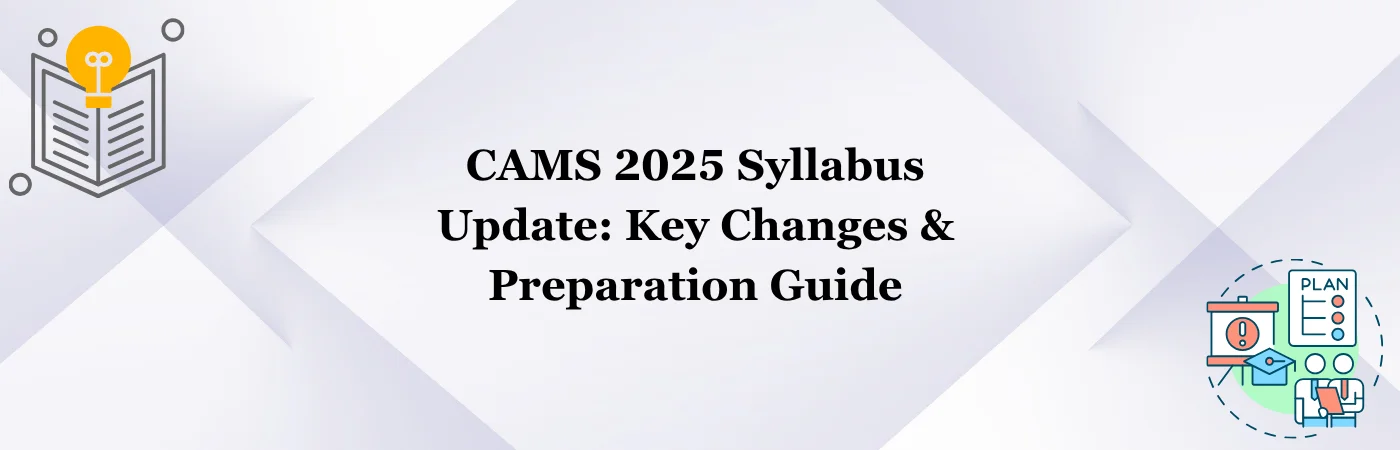
CAMS 2025 Syllabus Update | What's New & How To Prepare
If you’re planning to take the CAMS exam in 2025 , chances are you’re a bit nervous right now. The CAMS 2025 syllabus update has left many candidates confused, wondering what’s new, what’s removed, and how it will affect their preparation.
The good news? This blog is a comprehensive guide to the CAMS 2025 syllabus. We’ll walk you through the updates, key changes, exam structure, and preparation strategies so you can plan smarter, study with focus, and walk into the exam feeling confident.
CAMS Exam 2025 Update
The CAMS 2025 exam update has been officially introduced by ACAMS (Association of Certified Anti-Money Laundering Specialists). ACAMS regularly reviews and updates the syllabus to ensure it reflects the latest developments in financial crime, regulatory changes, and compliance practices worldwide. The aim behind this update is to keep certified professionals relevant and industry-ready.
Important to note : the updated CAMS 2025 syllabus applies to all candidates who register for the exam after 10th June 2025. Here, “registration” refers to the payment of exam fees, not just membership fees. So if you plan to register after this date, you have to prepare under the new syllabus, but if you already enrolled before 10th June 2025, you are eligible to give the exam under the old syllabus.
CAMS 2025 Syllabus Structure
The syllabus of CAMS 2025 consists of four major modules of learning. Here’s a quick overview of what the updated structure includes under each module:
1. Understanding the Risks and Methods of Financial Crime
The first pillar of the CAMS 2025 syllabus focuses on giving candidates a strong foundation in the risks, typologies, and methods of financial crime. In this module, you'll explore:
(You can also read our guide on how CAMS certification prepares you for the AML career).
2. Global AFC Frameworks, Governance, and Regulations
Module 2 of the CAMS 2025 syllabus is all about understanding the global anti-financial crime (AFC) frameworks and the governance systems that support them. In this module, you’ll explore:
3. Building an AFC Compliance Program
In the first two modules, you will build your knowledge of risks and global frameworks; this one shows you how to apply it in real-world operations. In this, you’ll cover:
4. Tools and Technologies to Fight Financial Crimes
Module 4 highlights the modern tools and technologies that compliance professionals rely on to detect and prevent financial crimes. In this module, you’ll explore:
CAMS 2025 Exam Syllabus: Major Updates You Must Know
The CAMS 2025 syllabus updates are designed to reflect the latest trends & growing role of technology. Here are some of the key changes as follows:
(For detailed guidance, check our Top 10 CAMS exam tips to pass on your first attempt).
How to Prepare for the CAMS 2025 Exam
To crack the CAMS exam on your first attempt, you should choose the right preparation method based on your learning style, time, & resources. Let's explore the most effective ways to prep for the updated CAMS 2025 exam:
AIA CAMS 2025 Prep Course :
The AIA CAMS Prep Course is designed to simplify the syllabus and make CAMS Exam preparation more structured. With AIA, you get industry expert guidance, live sessions, and much more. Some highlights of AIA’s program include:
Self-Study
Self-study is another way to prepare for the CAMS Exam, especially if you’re disciplined and prefer learning at your own pace. With the official ACAMS study guide, practice questions, and online resources, candidates can build a study plan that fits their schedule. However, it requires strong consistency and good time management. This works best for learners who are confident in researching and practicing independently, but it may take longer compared to guided prep courses.
ACAMS Prep Course
CAMS certification packages are the official training program offered by the Association of Certified Anti-Money Laundering Specialists. It is built directly around the CAMS 2025 syllabus and provides structured study materials, practice questions, and access to official resources.
While it ensures complete coverage of the syllabus, candidates often combine it with additional prep support, like AIA’s guided coaching, for more personalized learning and doubt-solving support.
What’s New in CAMS Certification 2025?
The CAMS Certification has been upgraded in 2025 to better match the evolving needs of AML professionals. Here’s a quick look at the changes:
1. Localized Content for Global Standards :
Instead of a one-size-fits-all approach, CAMS now includes region-focused AML regulatory content. This means professionals can learn how to apply international AML standards while staying aligned with their local compliance requirements.
2. Real-World Industry Case Studies :
The new update introduces sector-specific case studies, covering industries like banking, fintech, and insurance. These scenarios help candidates understand how financial crime prevention strategies actually work in different business environments.
3. Flexible Modular Learning Path :
The CAMS 2025 syllabus introduces a modular learning path, breaking content into 4 focused modules for easier step-by-step preparation. At AIA, we align with this flexibility by offering live, recorded, and self-paced learning, helping professionals study effectively while managing their busy schedules.
Conclusion
The CAMS 2025 syllabus update reflects how financial crime is evolving worldwide. By introducing new topics like RegTech, virtual assets, and updated global standards, ACAMS ensures that certified professionals stay ahead of regulatory expectations.
If you’re planning to take the exam, remember that the updated syllabus applies to candidates who registered after June 10, 2025. With four well-structured modules, the CAMS exam syllabus 2025 prepares you to thrive as an AML expert in a fast-changing financial world.
At AIA (Academy of Internal Audit), we help you simplify your CAMS preparation with structured guidance, updated study material, and expert mentorship, fully aligned with the syllabus. If you’re serious about earning your CAMS credential, now is the right time to start your journey with AIA.
FAQ :
1. When will this change apply?
The updated CAMS 2025 syllabus applies to candidates who registered for the exam after June 10, 2025. Registration here means paying the exam fee, not membership. If you registered before this date, the old syllabus applies.
2. If I registered before the update, will I follow the old or the new syllabus?
Candidates who registered (exam fee payment) before June 10, 2025, will follow the previous CAMS syllabus. All candidates who registered after this date should prepare on the basis of the CAMS 2025 syllabus update.
3. How will the syllabus changes affect the difficulty level of the exam?
The CAMS exam 2025 is not harder in format, but the content now includes updated topics like RegTech, virtual assets, and evolving financial crime risks. This means candidates need a more current and practical understanding of AML compliance.
4. What has been removed or merged?
Some repetitive and outdated topics have been merged or simplified to make the syllabus more streamlined. The focus has shifted toward emerging AML risks, technology, and regulatory expectations, ensuring the CAMS 2025 syllabus is both relevant and practical.
5. Do the syllabus changes affect the exam format or only the content?
The CAMS exam structure-2025 is remaining similar: 120 multiple-choice questions within 3.5 hours. What’s changed is only the syllabus content, with updated topics and reorganized modules to reflect the latest AML trends.
6. Will my old study material still be useful for the 2025 exam?
Old CAMS study material may still help with fundamentals, but it does not cover the new topics in the CAMS 2025 syllabus. To avoid knowledge gaps, it’s highly recommended to use the updated study guide and prep resources.
7. How can I access the updated CAMS 2025 study guide?
The official CAMS 2025 study guide can be accessed through your ACAMS account once you’ve registered for the exam. You can also supplement it with coaching and prep courses from institutes like AIA, which provide updated notes and guidance.
8. What is the passing score for the CAMS 2025 exam?
The passing score for the CAMS exam 2025 remains the same as earlier. Candidates must score 75 or higher out of 120 to qualify. The exam is scaled, so your performance is measured against the overall difficulty level of the test.